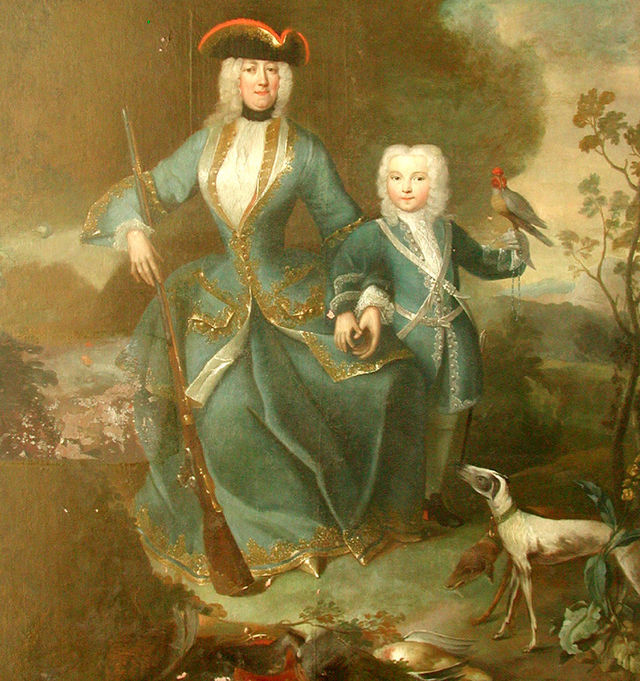
Eleonore Amalia of Lobkowicz (20 June 1682 in Mělník – 5 May 1741 in Palais Schwarzenberg, Vienna) was a member of the Princely House of Lobkowicz by birth, and a Princess of Schwarzenberg by marriage.
Biography
Princess Eleonore Amalia of Lobkowicz, was a daughter of Prince Ferdinand August of Lobkowicz (1655–1715), the Duke of Sagan, and his second wife, Margravine Maria Anne Wilhelmine of Baden-Baden (1655–1701), daughter of Wilhelm, Margrave of Baden-Baden.
On 6 December 1701 Princess Eleonore married the Austrian Hofmarschall, Adam Franz Karl Eusebius, Hereditary Prince (and later Prince) of Schwarzenberg. Eleonore was considered a cultivated woman, and her and her husband's wealthy and cultured lifestyle was often displayed at court. The marriage produced two children:
Maria Anna of Schwarzenberg (1706–1755); married Louis George, Margrave of Baden-Baden in 1721.
Joseph I Adam of Schwarzenberg (1722–1782); married Princess Maria Theresia of Liechtenstein (1721-1753) in 1741.
After 21 years of marriage her husband was killed in a hunting accident on imperial land near Brandýs nad Labem-Stará Boleslav, today in the Czech Republic. Emperor Charles VI fired the deadly shot, and the prince just happened to be in the way. Afterwards, the emperor took Eleonore's son to his court in Vienna, and she was paid a baronial maintenance of 5,000 guldens.
Princess Eleonore died on 5 May 1741 in the Palais Schwarzenberg in Vienna. Franz von Gersdorf, the emperor's physician, requested an autopsy from which the cause of death has been diagnosed as cervical cancer.
Inspirational character Bram Stoker?
In 2007, the Austrian documentary The Vampire Princess analyzes the legend according to which Eleonore was a vampire. This report by Klaus Steindl, broadcast on the European channel Arte, claims that Princess Eleonore could be one of Bram Stoker's sources of inspiration for his character of the vampire-princess Lenore, in his gothic novel Dracula. In fact, suffering from a mysterious ailment which made her suffer greatly, the princess spent fortunes on remedies based on potions, but also on esoteric and magical formulas that the Church disapproved of which fueled rumors about a " evil of the vampires ”which she allegedly contracted from one of these monsters.
For their part, the authorities feared that the illness from which she was suffering, and which was worsening, would spread. Doctor Franz von Gerstoff, doctor of the Emperor, went to his bedside and decided on his transfer to Vienna. After the death of the princess, an autopsy was performed (rare for the time, perhaps to silence rumors) by dissecting her entrails, swollen, and removing her healthy heart. She was therefore religiously buried in the chapel of Saint John of Nepomuk of the St. Vitus Cathedral of Krumau, but all the same in a tomb sealed by a masonry vault of an abnormal thickness, under a tombstone engraved with a head of dead!
Much later, his great-grandson, Karl Philipp, Prince of Schwarzenberg, will be the victor of Napoleon at the battle of Leipzig, in 1813.
It was not until the 20th century that analysis of the symptoms and re-reading of the autopsy reports identified his disease as colon cancer and nothing that we had previously imagined.
Styles
1682 – 1701: Princess Eleonore of Lobkowicz
1701 – 1703: Her Serene Highness The Hereditary Princess of Schwarzenberg
1703 – 1732: Her Serene Highness The Princess of Schwarzenberg
1732 – 1741: Her Serene Highness The Princess Dowager of Schwarzenberg
Princess Eleanore on Wikipedia in English:
Wikipedia page
Page translated into the following languages:
·
مصرى
·
Deutsch
·
French
·
Español
·
Magyar
·
Italiano
·
Português
·
Русский
·
Svenska
Source: Girl In The Tiara
To access this website, you must be aged 18 or more.
By giving an affirmative answer, you confirm being of age.
Are you 18 years old or more?
Pour visiter ce site, vous devez être âgé(e) de 18 ans ou plus.
En répondant par l'affirmative, vous confirmez être majeur.
Êtes-vous âgé(e) de 18 ans ou plus ?